introduction
Since its publication in 1865, Alice’s Adventures in Wonderland by Lewis Carroll has enchanted readers with its whimsical narrative, strange characters, and fantastical settings. Carroll’s book isn’t merely a children’s story; it’s a deep, layered work that has inspired countless adaptations, analyses, and explorations. From the curious characters to the unique philosophies, Carroll created a world that questions reality, challenges logic, and celebrates the power of imagination. This article will explore Alice’s Adventures in Wonderland from its background and characters to its themes, literary impact, and enduring cultural legacy.
The Origins of Alice’s Adventures in Wonderland
The Story Behind the Story
The inspiration for Alice’s Adventures in Wonderland began on a sunny afternoon in 1862, during a boat trip down the River Thames in Oxford, England. Lewis Carroll, a pen name for Charles Lutwidge Dodgson, was accompanied by his friend Robinson Duckworth and three young sisters: Lorina, Alice, and Edith Liddell. To entertain the girls, Carroll improvised a whimsical story about a young girl named Alice who fell into an imaginary world filled with quirky characters and nonsensical adventures. The story delighted Alice Liddell, who asked Carroll to write it down, leading to the book’s publication three years later.
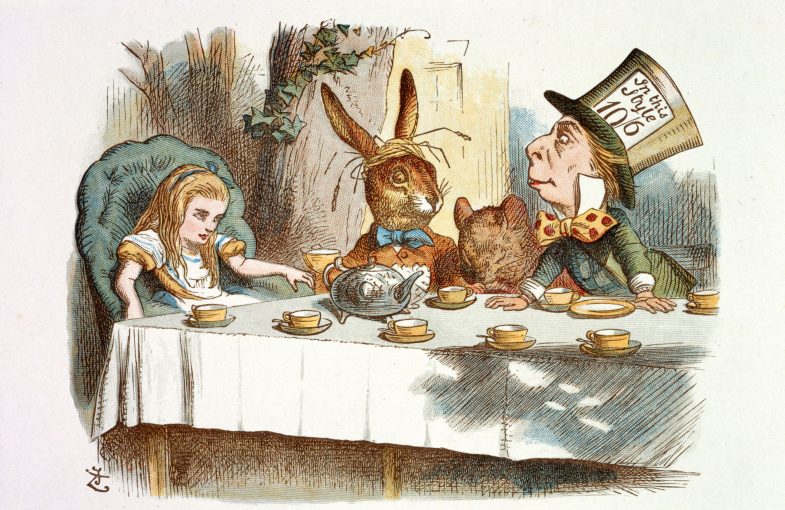
The published book, Alice’s Adventures in Wonderland, was illustrated by John Tenniel and quickly gained popularity among both children and adults. Carroll’s blending of playful language, satire, and absurdity opened doors to endless interpretations, ensuring its place as a beloved and timeless piece of literature.
Lewis Carroll: A Mathematician and a Wordsmith
Carroll’s background as a mathematician and logician greatly influenced the story. He used playful language, riddles, and paradoxes to create a world where logic is turned on its head, mirroring the nonsensical but rule-bound world of mathematical puzzles. This unique perspective created a distinct narrative style that set Alice apart from other children’s literature at the time and continues to fascinate readers and scholars alike.
Plot Overview
The story begins with Alice, a young girl sitting by a riverbank, when she notices a white rabbit wearing a waistcoat and muttering to itself about being late. Alice, intrigued, follows the rabbit down a rabbit hole, which plunges her into Wonderland—a strange, dreamlike world governed by its own peculiar logic.
Throughout her journey, Alice encounters an array of fantastical characters, including the Cheshire Cat, the Mad Hatter, the Queen of Hearts, and the Caterpillar. Each character presents Alice with new challenges, questions, and absurd rules that test her perception of reality and her understanding of identity, authority, and common sense. Eventually, Alice’s adventures come to an end as she wakes up, realizing that her journey was a dream.
Major Themes in Alice’s Adventures in Wonderland
1. The Nature of Reality and Identity
One of the most profound aspects of Alice’s Adventures in Wonderland is its exploration of reality and identity. Wonderland is a place where the conventional rules of reality do not apply. Size and scale constantly change, logic is subverted, and conversations often lead to more confusion than clarity. This lack of stability challenges Alice’s perception of who she is. Her journey through Wonderland is as much about self-discovery as it is about navigating a bizarre world.
The question of identity is central to Alice’s experience. Throughout the story, Alice is asked to question who she is, often literally. In her encounters with characters like the Caterpillar, she is forced to articulate her own sense of self in a world that continuously undermines her ability to do so.
2. The Absurdity of Authority
Carroll’s characters, particularly the Queen of Hearts and the various “official” figures in Wonderland, often parody real-world authority. The Queen of Hearts rules through capricious and often nonsensical demands, her most famous being “Off with their heads!” for the slightest perceived offense. This theme illustrates Carroll’s critique of arbitrary authority and the absurdity of power when divorced from reason.
3. Language, Logic, and Nonsense
Alice’s Adventures in Wonderland plays with language in ways that make it both funny and thought-provoking. Carroll was a master of wordplay, puns, and riddles, and he used these tools to create a narrative where language doesn’t necessarily lead to understanding or clarity. Instead, conversations in Wonderland often lead to miscommunication or even greater confusion.
By challenging traditional uses of language, Carroll reflects the complexity and limitations of communication. The famous “Jabberwocky” poem in the book’s sequel, Through the Looking-Glass, is a perfect example of Carroll’s ability to invent language that feels like it should make sense, even though it doesn’t.
Key Characters and Their Symbolic Significance
1. Alice
Alice is a curious, brave, and questioning protagonist. Unlike many traditional fairy-tale heroines, she is assertive, quick to challenge nonsense, and continually questions the strange rules she encounters in Wonderland. Her curiosity often leads her into situations where she must rely on her own wits to navigate, making her an active participant in her journey.
2. The Cheshire Cat
The Cheshire Cat is perhaps one of the most enigmatic characters in Wonderland. Known for its mischievous grin and ability to disappear, the Cheshire Cat offers cryptic advice to Alice, embodying the unpredictable and illogical nature of Wonderland itself. The Cat’s tendency to question Alice’s understanding of the world and offer paradoxical advice makes it a symbol of the uncertainty and mystery that pervades Wonderland.
3. The Mad Hatter and the March Hare
The Mad Hatter and the March Hare are central figures in the tea party scene, one of the book’s most famous episodes. Their nonsensical conversation and bizarre behavior highlight the theme of madness and question the nature of sanity. In Wonderland, “madness” is not a flaw but rather a part of the natural order. The tea party scene, in particular, is an exploration of time and rules, with the Hatter’s nonsensical relationship with time underscoring the lack of conventional logic in Wonderland.
4. The Queen of Hearts
The Queen of Hearts is an authoritarian figure whose random and violent declarations of “Off with their heads!” serve as a satire of tyranny. She represents the absurdity of power when it is detached from logic and justice. The Queen’s rule is not based on any kind of moral authority but rather on her whims, showcasing Carroll’s critique of arbitrary rule and authority.
Literary Techniques and Style
Lewis Carroll’s use of language and literary techniques contributed greatly to the story’s lasting impact. Some notable techniques include:
• Wordplay and Puns: Carroll’s love for language is evident in his use of puns and wordplay throughout the book. This playful manipulation of language keeps the story lively and humorous, allowing readers to appreciate the richness of English in new ways.
• Dream Logic: Carroll employs a dreamlike structure where events unfold in a way that defies conventional cause-and-effect. This allows for an exploration of reality that feels unpredictable and, at times, surreal.
• Symbolism: Many characters and scenes in Wonderland serve as symbols or parodies of Victorian society, education, and even philosophical concepts. For example, Alice’s size changes reflect the constant shifts in identity and self-perception that children experience as they grow.
The Impact and Legacy of Alice’s Adventures in Wonderland
Since its publication, Alice’s Adventures in Wonderland has become one of the most quoted, adapted, and analyzed books in English literature. Its influence spans a broad range of fields, from psychology to philosophy, art, and film. The book’s popularity has inspired countless adaptations, including animated films, live-action movies, stage plays, and even theme park attractions.
Influence on Literature and Pop Culture
Carroll’s work has inspired writers and artists around the world. Authors like James Joyce, Jorge Luis Borges, and Virginia Woolf have drawn from Carroll’s ideas of fluid reality and identity in their own works. The book’s whimsical language and logic have also influenced modern storytelling, especially in fantasy and science fiction genres.
Psychological and Philosophical Interpretations
The story has been analyzed from psychological and philosophical perspectives. Sigmund Freud and Carl Jung have both referenced Alice’s Adventures in Wonderland in their work, using the story as a springboard for exploring ideas about the unconscious mind, dreams, and the nature of reality. Philosophers have examined the book’s exploration of identity, language, and logic, seeing in it a reflection of existential and absurdist thought.
Cultural Endurance
Alice’s Adventures in Wonderland continues to resonate because it appeals to readers of all ages. For children, it is a fantastical adventure filled with humor and strange creatures. For adults, it offers a deeper look into the absurdities of life, authority, and personal identity. The story’s blend of whimsy and wisdom has ensured its place as a cultural touchstone, inspiring new interpretations and adaptations over a century and a half after its original publication.
Conclusion: The Timeless Appeal of Wonderland
In the world of Alice’s Adventures in Wonderland, the ordinary rules of life are delightfully subverted. Carroll invites readers to step into a world where the boundaries of reality are blurred, and logic is both nonsensical and revealing. Through Alice’s journey, readers of all ages are encouraged to embrace curiosity, question authority, and celebrate the bizarre and beautiful complexities of the imagination.
Wonderland continues to enchant because it speaks to a universal part of the human experience: the desire to explore, to question, and to dream. In a world increasingly bound by structure and routine, Alice’s Adventures in Wonderland remains a refreshing escape—a reminder of the joy, wonder, and wisdom
Read More »